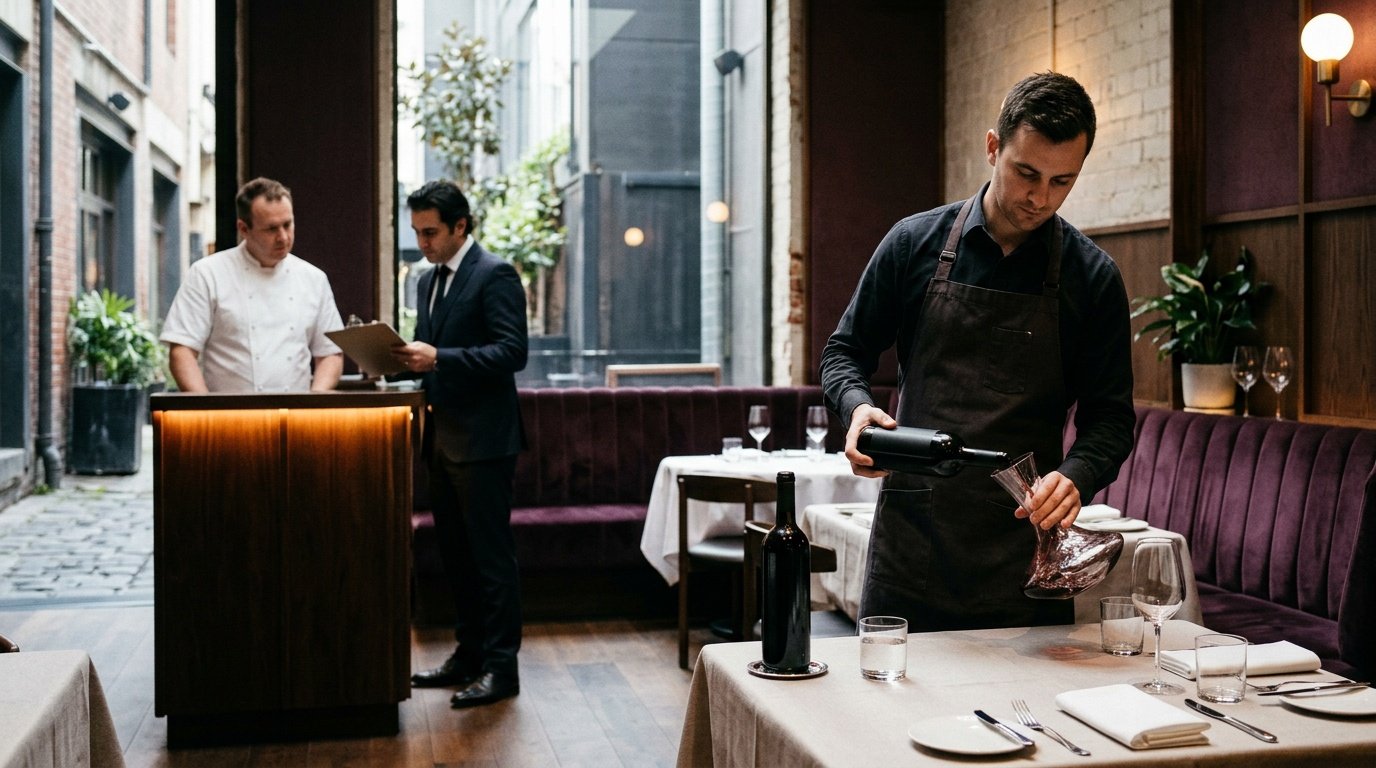
Tom runs a 60 seat degustation room off a Fitzroy laneway. Last financial year the restaurant turned over $2.6 million. He wants two people. Kenji is a sushi chef in Osaka with IELTS 5.0 overall and 4.0 in writing. Lucie is a sommelier already on his floor in Melbourne, on a temporary visa. She turned 47 in June. Under the standard program, Kenji’s English falls short and Lucie has no occupation to nominate. Under the Restaurant (Premium Dining) Industry Labour Agreement, both files open. However, the first number the Department reads is not a salary or a test score. It is Tom’s revenue.
Short answer: Only a non-franchised restaurant with a wine list can request the agreement. Revenue must be at least $2 million a year. It buys an English concession for the 482 and 494. It adds an age cap of 55 for the 494 and 186. It also gives trade waiters a nomination code. It buys no salary discount. The $79,423 threshold and the market rate apply in full.
The $2 million gate, and the 30 day duty behind it
Home Affairs defines a premium dining restaurant by six attributes. You must meet all six, not most of them. The terms below were checked on 14 October 2026 on the Home Affairs page and in the template agreement.
| Attribute | What the definition says |
|---|---|
| Revenue | At least $2 million per annum |
| Ownership | Non-franchised |
| Wine | The restaurant offers a wine list |
| Staff | Employs highly experienced staff |
| Front of house | Requires specialised staff, such as trade waiters, sommeliers and maitre d’s |
| Back of house | Requires specialised staff, such as wok chefs, sushi chefs and specialised cuisine chefs |
The gate does not close behind you once the agreement is signed. Instead, clause 9.2 of the template makes it a continuing duty. If the restaurant stops meeting the definition, you must tell the Department within 30 days. So a revenue dip or a franchise deal each triggers that notice. The agreement itself runs for five years from its effective date. Our guide to labour agreements in 2026-27 explains how an industry template differs from a company specific deal.
Three things the agreement changes, and one it leaves alone
Employers often assume an industry agreement discounts everything. This one is narrower. Therefore, read the concessions as a short list.
| Rule | Standard program | Under the restaurant agreement |
|---|---|---|
| English, 482 and 494 | Standard test scores | IELTS 5.0 overall, 4.5 in listening and speaking, 4.0 in reading and writing, or equivalent |
| English, 186 | Standard requirement | No change |
| Age, 494 and 186 | Under 45 at lodgement | Under 55 at lodgement |
| Age, 482 | No limit | None published |
| Trade waiter | No occupation to nominate | Nominated under code 070499, covering sommeliers and maitre d’s |
| Salary | Market rate and $79,423 threshold | Nil concessions. Same rule. |
The occupation list is four long: Chef 351311, Cook 351411, Cafe or Restaurant Manager 141111 and Trade Waiter. For the first three, the ANZSCO tasks apply with no concession. In contrast, the trade waiter role adds Restaurant Industry Award 2020 duties to the ANZSCO waiter tasks. Cellar work and wine recommendations sit in that list. All five ANZSCO waiter specialisations qualify, from drink waiter to wine steward.
Kenji and Lucie: the same agreement, two different tests
Kenji is nominated as a Chef, 351311. His skills, qualifications and experience must meet the standard Skills in Demand rules for that occupation. The agreement gives him nothing there. His English is where it helps. IELTS 5.0 overall with 4.0 in writing clears the agreement’s bar for the 482. Because there is no published age limit for the 482, his age is not a question. Tom must still show the position is full time, ongoing and available for at least two years. After two years as a primary 482 holder in the occupation, Kenji can be nominated for the 186.
Lucie is nominated as a Trade Waiter under code 070499. The template gives her three routes. The first is a Certificate III in Hospitality (Restaurant Front of House), or an RTO assessed equivalent. That route also needs 12 months of relevant work after any course placements. The second is 18 months of relevant work in Australia on a temporary visa. The third is two years of relevant experience anywhere. Her 186 comes later than Kenji’s. Managers and trade waiters need three years as a primary 482 holder in the occupation first. She also needs three years of full time relevant work in Australia. At 47 she is over the standard limit of 45. Under the agreement’s cap of 55, the 186 stays open if she lodges in time.
No discount on the pay slip
Schedule 2, item 3 of the template reads “nil concessions”. Consequently, the salary rules are the ordinary ones. The annual earnings must meet the market rate for the role. They must also reach the Core Skills Income Threshold, which is $79,423 for nominations lodged from 1 July 2026. For the 494, the regional threshold sits at the same figure. In addition, clause 5.8 requires a full time, ongoing position available for at least two years. A seasonal roster or a part time sommelier does not fit. Our article on the three salary tests on a 482 shows how the market rate is evidenced.
Two advertisements, six months, one with national reach
Labour market testing applies to every 482 and 494 nomination under the agreement. Schedule 3 asks for at least two attempts in the six months before you lodge. One must have national reach, for example Seek, Indeed, Workforce Australia or an industry website. The other may be local, including your own website. Our guide to the eight ways a 482 advertisement fails covers what each advertisement must contain.
One practical note from the Department’s own page. The ImmiAccount form for an industry labour agreement currently shows a compulsory stakeholder consultation field. Home Affairs says to enter “n/a” there unless you are requesting the aged care agreement. There is no named endorsing body and no request fee for the restaurant agreement.
From request to permanent residence
- Step 1Confirm the restaurant meets all six attributes, with the revenue figure documented.
- Step 2Request the agreement. The Department charges nothing. It runs five years, with a nomination ceiling per occupation per year.
- Step 3Advertise twice within six months, one advertisement national.
- Step 4Nominate within the ceiling at the market rate and above $79,423, full time, for at least two years.
- Step 5Visa grant. The 482 can run for up to four years.
- Day 7Workplace rights information handed to the worker.
- Year 2Chefs and cooks become eligible for the 186 nomination.
- Year 3Managers and trade waiters become eligible for the 186 nomination.
Ceilings can be raised on request. However, the Commonwealth makes the final decision each year, and the template says more places are not assured. Plan nominations against the ceiling, not the roster.
What the Commonwealth charges
The sponsor pays every figure below. Schedule 6 of the template also bars charging the worker for the nomination or for securing the job. Likewise, you cannot nominate anyone you reasonably suspect owes money for being recruited. Our guide to sponsor costs you cannot pass on lists the rest.
Turnover of $10 million or more lifts the levy to $1,800 a year. Sponsorship approval costs $420. At the 186 stage, the nomination is $540 and the levy is $3,000 or $5,000 one-off. The 186 and 494 visas each start from $6,140.
Before you request the agreement
Schedule 6 also requires direct payment of salary, taxes and superannuation. Deductions need written consent that mainly benefits the worker, or an award, enterprise agreement or law behind them. Finally, the Department can ask for a report within 30 days at any point. It covers workforce plans, advertising in the last 12 months and salaries paid.
Frequently asked questions
Our revenue dropped below $2 million this year. What do we have to do?
The template requires you to notify the Department within 30 days of no longer meeting the premium dining definition. What follows is a decision for the Department under the agreement. Take advice before the notice goes in.
Can I nominate a sommelier who has no formal hospitality qualification?
Yes, on two of the three routes. The trade waiter can qualify with 18 months of relevant work in Australia on a temporary visa. Two years of relevant experience anywhere also works. The certificate route is the third option, not the only one.
Is there an age limit for a chef on the 482 under this agreement?
Home Affairs publishes no age limit for the 482. The cap of 55 at lodgement applies to the 494 and the 186 only. For those two visas it replaces the standard limit of 45.
Can a labour hire company place the chef with us under the agreement?
Only within limits. Any labour hire provider must be reputable and licensed where licensing is required. Once employed, the worker must work directly for the restaurant. You must also be able to show how you monitor the provider.
The ImmiAccount request form asks who we consulted. Who is that for a restaurant?
Nobody. Home Affairs says the compulsory stakeholder consultation field is an error for industry agreements other than aged care. Enter “n/a” in those fields until the form is fixed.
Agreement terms verified 14 October 2026 on the Department of Home Affairs page Industry labour agreements and in the Restaurant (Premium Dining) Industry Labour Agreement template, clauses 5 to 9 and Schedules 1 to 7. Threshold and charges as at 1 July 2026 on Home Affairs visa pricing.
General information as at 14 October 2026. Tom, Kenji and Lucie are a fictional example. Not legal advice.